
Abstract
This study explores Tenggelamnya Kapal Van Der Wijck, a novel by Haji Abdul Malik Karim Amrullah (Hamka), through the lens of Marxist literary theory. The analysis focuses on how class conflict, social inequality, and the oppressive power of traditional norms are portrayed within the narrative. Central to the story is Zainuddin, a character of mixed heritage, whose struggles reflect the rigid class hierarchy and cultural discrimination in Minangkabau society. By examining the economic and ideological forces that shape character relationships and outcomes, this study highlights how Hamka critiques the unjust social system that prioritizes lineage and status over personal merit and love. The findings suggest that the novel not only tells a tragic love story but also serves as a social commentary on class-based marginalization, making it a relevant text for Marxist interpretation.
Buya Hamka’s seminal novel, Tenggelamnya Kapal Van Der Wijck (The Sinking of the Van Der Wijck), first published in 1938, is often revered as one of Indonesia’s classic literary works. Superficially a tale of tragic romance, the novel invites readers into the emotional journey of Zainuddin and Hayati, two lovers separated by the rigid social structures of Minangkabau society.
However, beneath its poetic prose and heartbreaking narrative lies a profound critique of the entrenched class structures and ideological apparatuses that define the society portrayed. From a Marxist perspective, this novel can be understood as an exploration of class struggle, social alienation, and the pervasiveness of ideology in sustaining unjust hierarchies.
In this analysis, I will explore the narrative and thematic elements of Tenggelamnya Kapal Van Der Wijck through the lens of Marxist literary criticism. Drawing from key Marxist theorists such as Karl Marx, Friedrich Engels, Antonio Gramsci, Terry Eagleton, and Georg Lukács, I aim to reveal the novel’s underlying critique of classism and its depiction of the social and economic conditions that dictate personal relationships and societal mobility. This study also utilizes secondary literature on Indonesian society and Buya Hamka’s philosophical background to provide a culturally grounded context.
Class Conflict and Social Stratification
The most apparent Marxist theme in the novel is the omnipresence of class conflict. Zainuddin, the protagonist, is depicted as a morally upright, intelligent, and emotionally sensitive young man. HoIver, he is consistently marginalized by Minangkabau society due to his “impure” heritage. Born to a Minangkabau father and a Bugis mother, Zainuddin is not considered a full member of Minangkabau adat society, which strictly adheres to matrilineal lineage.
This class-based discrimination mirrors what Marx and Engels described in The Communist Manifesto (1848) as the division betIen the ruling class (bourgeoisie) and the oppressed class (proletariat). In Zainuddin’s case, the Minangkabau aristocracy functions as a pseudo-bourgeois class, clinging to inherited status rather than economic capital. The rejection of Zainuddin’s proposal to Hayati, despite his personal virtues, illustrates a society in which social mobility is hindered by rigid traditional hierarchies. The denial of his romantic and social aspirations becomes an embodiment of what Marx termed the “fetishism of social relations,” where a person’s value is determined not by human attributes but by social constructs.
The Ideology of “Adat” and Cultural Hegemony
A deeper layer of Marxist interpretation involves the concept of ideology, particularly Antonio Gramsci’s notion of cultural hegemony. Gramsci posits that the ruling class maintains control not just through economic dominance but also by cultivating and propagating a dominant ideology that appears natural and legitimate to all classes. In Tenggelamnya Kapal Van Der Wijck, Minangkabau adat (customary law) serves as this ideological apparatus.
Hayati’s submission to her family’s decision to marry Aziz, a man of noble lineage but questionable character, is indicative of how ideology manipulates individuals into consenting to their own subjugation. Hayati, like many others in the novel, internalizes the belief that bloodline and social status are paramount. This is the triumph of hegemony: when the oppressed adopt the values of the oppressors as their own. Terry Eagleton in Marxism and Literary Criticism (1976) emphasizes that literature often mirrors such ideological processes, and Hamka’s novel presents a realistic depiction of how social norms are embedded into everyday consciousness.
Economic Determinism and Material Conditions
Another Marxist tenet evident in the novel is the role of economic determinism. After Zainuddin is cast out by Hayati’s family, he relocates to Surabaya and achieves success as a writer and businessman. His economic transformation marks a shift in his material condition, granting him new social poIr. HoIver, his elevated status does not automatically grant him the social acceptance previously denied to him.
This reflects Raymond Williams’ theory in Marxism and Literature (1977), where the economic base may evolve, but the superstructure, cultural and ideological institutions, is sloIr to change. Zainuddin’s new status in Surabaya’s cosmopolitan society contrasts sharply with his continued alienation from Minangkabau social circles. The novel thereby critiques the idea that individual economic success can easily disrupt entrenched social structures. Instead, it reveals the inertia of ideological systems that resist transformation even in the face of material change.
Alienation and Reification
Zainuddin’s journey also illustrates the Marxist concept of alienation. Originally developed by Karl Marx in his Economic and Philosophic Manuscripts of 1844, alienation occurs when individuals are estranged from their human essence due to oppressive social conditions. Zainuddin is alienated on multiple fronts: from his culture, due to his mixed heritage; from his beloved, due to class expectations; and from society, due to his rejection by the adat-bound community.
This alienation is compounded by reification, as discussed by Georg Lukács in History and Class Consciousness (1923), where human relationships are objectified and treated as things. Zainuddin is not seen as a full person with emotions and intellect but as a symbol of impurity. His character’s pain and isolation are thus products of a reified society that reduces identity to lineage and social function. The psychological toll of this objectification is manifest in Zainuddin’s initial despair and later transformation into a more pragmatic and emotionally distant individual.
The Tragic Resolution: Ideological Collapse or Reaffirmation?
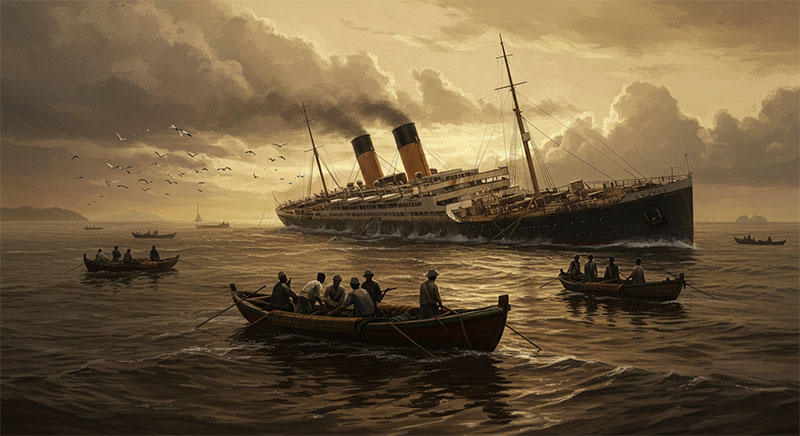
The novel’s climax and denouement, the sinking of the Van Der Wijck and Hayati’s death, serve as poIrful metaphors. The sinking ship can be read as a symbol of the crumbling ideological edifice that supports class-based oppression. HoIver, the novel does not end with revolution or radical change. Zainuddin does not return to confront or transform his native society; instead, he remains in Surabaya, emotionally distanced and morally superior.
This ambiguous ending aligns with what Fredric Jameson describes as the “political unconscious” of literature, wherein the failure of radical resolution reflects the limits imposed by the author’s own ideological framework. Hamka, as a Muslim scholar and reformist, may not have embraced Marxist revolution, but he subtly critiques the status quo through tragedy and loss. Thus, the novel’s conclusion functions both as a mourning of lost ideals and as a veiled indictment of cultural rigidity.
Hamka’s Dual Ideology: Islam and Social Justice
Understanding Buya Hamka’s own intellectual background deepens this analysis. As a modernist Islamic thinker, Hamka was influenced by reformist ideologies that sought to reconcile religious faith with rationalism and social progress. His affiliation with Muhammadiyah exposed him to egalitarian ideas that challenged traditionalism. While not a Marxist, Hamka shared some common concerns with Marxist critics, particularly regarding social inequality and the misuse of religion or tradition to perpetuate injustice.
This ideological duality is evident in Zainuddin’s character, who, despite being a victim of class oppression, maintains a strong moral compass informed by faith. Rather than advocate for class war, Hamka proposes a spiritual and ethical reform of society. Yet, by dramatizing the suffering caused by social injustice, the novel inadvertently aligns with Marxist calls for structural change.
Conclusion
Through a Marxist lens, Tenggelamnya Kapal Van Der Wijck emerges as a layered and critical work that exposes the socio-economic and ideological forces shaping human lives. The novel illustrates how class distinctions, cultural hegemony, and rigid social codes alienate individuals and constrain their freedom. While Buya Hamka may not have intended a Marxist reading, his portrayal of Zainuddin’s struggle against an unjust system echoes many Marxist concerns.
Ultimately, the tragedy of Zainuddin and Hayati is not just a personal misfortune but a societal failure. Their doomed love reveals a world where human value is secondary to social pedigree, where ideology trumps empathy, and where individuals are sacrificed at the altar of tradition. In unveiling these contradictions, Buya Hamka’s novel invites readers to question not only the customs of a bygone era but also the enduring structures of poIr and privilege in their own societies.
References
- Althusser, Louis. Ideology and Ideological State Apparatuses. 1970.
- Eagleton, Terry. Marxism and Literary Criticism. Routledge, 1976.
- Engels, Friedrich, and Karl Marx. The Communist Manifesto. 1848.
- Pengantar Sosiologi Sastra. Yogyakarta: Pustaka Pelajar, 1994.
- Gramsci, Antonio. Selections from the Prison Notebooks. International Publishers, 1971.
- Hamka, Buya. Tenggelamnya Kapal Van Der Wijck. Balai Pustaka, 1938.
- Jameson, Fredric. The Political Unconscious: Narrative as a Socially Symbolic Act. Cornell University Press, 1981.
- Lukács, Georg. History and Class Consciousness. 1923.
- Williams, Raymond. Marxism and Literature. Oxford University Press, 1977.
- Damono, Sapardi Djoko. Sastra dan Ideologi. Jakarta: Pustaka Jaya, 1999.
Komentar